If you’ve ever looked into importing a used car from Japan, you’ve run into the term “auction sheet.” Sellers mention it constantly, and for good reason. It’s the single most useful document you can get before buying a car you can’t physically see.
This guide explains what it is, how to read it, and where people tend to get caught out. If you want to check a sheet you’ve already received, you can use an auction sheet verification service to confirm it’s genuine.
What an auction sheet actually is
Japan has a huge network of wholesale car auctions, with dealers and trade buyers bidding on thousands of vehicles every week. Before a car goes up for sale, an independent inspector at the auction house goes over it and records what they find on a single sheet. That sheet is the auction sheet.
It covers the car’s basic details, an overall condition grade, separate interior and exterior grades, and a diagram marking every dent, scratch, repair and problem the inspector spotted. Because the inspector works for the auction house, not the seller, the sheet is considered far more trustworthy than a dealer’s own description.
Major auction houses include USS, TAA, HAA, CAA, JU and Aucnet, and each has its own layout and slight variations in grading. The basics are the same across all of them.
The main parts of the sheet
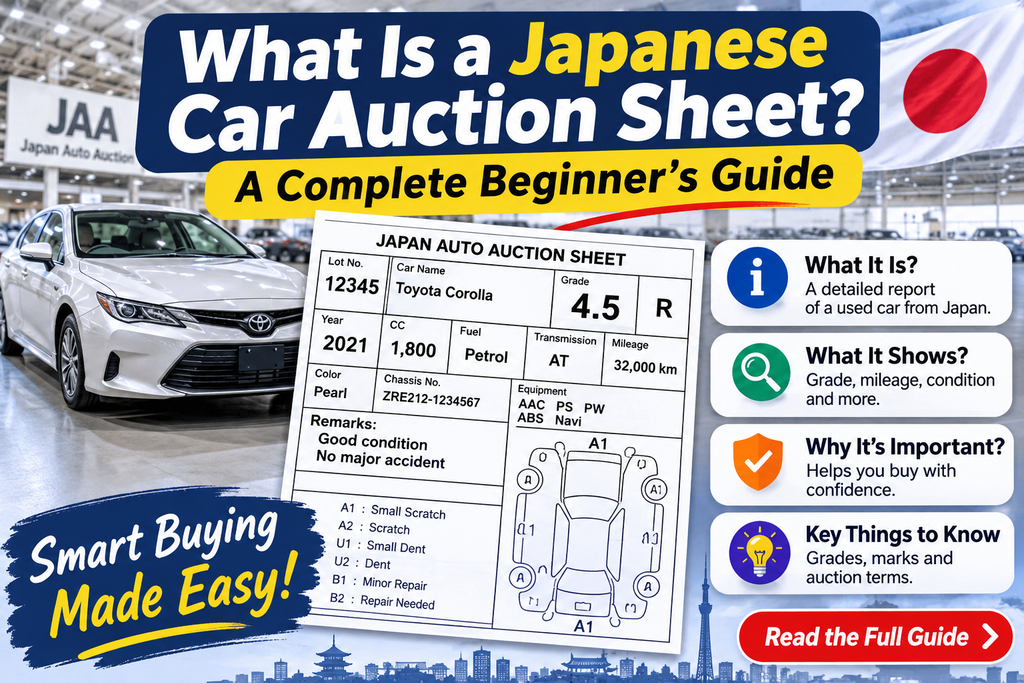
Top section: vehicle details. You’ll find the auction name, the date, and a lot number. Next come the make, model, year of registration, chassis number, engine size, transmission type, colour and mileage. The chassis number is the one to write down. It lets you cross-check the car against other records.
Overall grade. Usually shown in a box near the top, this is the headline number everyone looks at first. More on this below.
Interior and exterior grades. These are shown as letters, normally from A (excellent) to E (poor).
The car diagram. A simple line drawing of the car, seen from above, with the inspector’s marks and codes written on it.
Inspector’s notes. Written in Japanese, usually in a box on the side or bottom. These often contain the most important details, including repairs, odours, water damage, or non-original parts.
Equipment codes. Short abbreviations listing features such as air conditioning, power windows, sunroof, alloy wheels and navigation.
Understanding the overall grade
Here’s how the grades generally work:
- S or 6: Essentially new, extremely rare
- 5: Excellent, almost no flaws
- 4.5: Very good, minor marks only
- 4: Good, some small scratches or dents
- 3.5: Average, visible wear but nothing serious
- 3: Below average, noticeable damage or wear
- 2 or 1: Poor, significant problems
- 0: Heavy damage, often accident-related
- R or RA: The car has been in an accident and repaired. RA usually means a minor repair, R means something more significant
Most cars sold for export fall between 3.5 and 4.5. A car graded 4 or 4.5 is usually a safe bet. A 3.5 can be a bargain if the problems are cosmetic. Anything graded R or RA deserves a close look at the inspector’s notes before you decide.
Interior and exterior grades
These work the same way across the sheet. A is excellent, B is good, C is average, D is poor and E is very poor. A car might carry something like “4 / B / B”, which tells you it’s in good shape overall with decent interior and exterior condition.
If the overall grade looks strong but the interior is a D, that’s a sign the car may have been smoked in or heavily used, and the notes will usually say more.
Reading the damage codes
The diagram uses a letter for the type of damage, followed by a number from 1 to 3 showing how severe it is. A higher number means worse. So A1 is a barely visible scratch, while A3 is a deep, obvious one.
The common codes:
- A: Scratch
- U: Dent
- W: Wavy panel, which often signals a repair or repaint
- S: Rust
- C: Corrosion
- P: Paint fading or peeling
- Y: Crack
- X: Panel needs replacement
- XX: Panel has already been replaced
You’ll sometimes see combinations, such as A2U1, meaning a medium scratch and a small dent in the same spot. Exact codes can vary slightly between auction houses, so it’s worth checking if a code looks unfamiliar.
Why the inspector’s notes matter
New buyers often fixate on the grade and skip the written comments, and that’s a mistake. A car can score a respectable 4 and still have notes mentioning flood damage, a repainted roof, a replaced engine, or a rolled-back odometer warning. Grades are a summary. The notes are where the specifics live.
If you can’t read Japanese, use a translation service or work with an exporter who provides translations. Machine translation of the handwritten or stylised text is hit and miss, so a human translation is worth paying for on any car you’re serious about.
Mileage and what the sheet says about it
Auction inspectors flag cars where the mileage can’t be trusted. Look for notes about the odometer being changed, replaced, or showing signs of tampering. A clean sheet with no mileage warning is a good sign, though it’s not an absolute guarantee. Japan’s auction system has a good reputation here, but it’s still worth confirming the chassis number and checking service history when it’s available.
Common mistakes beginners make
Buying on grade alone. A grade of 4 means different things on different cars. Always read the diagram and notes.
Trusting a sheet you can’t verify. Fake and altered sheets do exist. Ask your exporter whether they can confirm the sheet against the auction house’s own records, and make sure the chassis number matches the car you’re buying.
Ignoring the interior grade. Smoke, pet smells and heavy wear are hard and expensive to fix.
Assuming R or RA means avoid. Plenty of repaired cars are perfectly fine, especially minor repairs. It depends on what was repaired and how well.
Skipping translation. The Japanese notes are not optional reading.
How to use it when buying
Start by checking the overall grade and the interior and exterior letters to see if the car fits your budget and expectations. Then read the diagram and match each mark to its code. Finally, get the inspector’s notes translated and look for anything that changes the picture, such as water damage, repaints, or non-original parts.
If anything is unclear, ask your exporter before bidding. A good one will explain the sheet and tell you honestly if a car isn’t worth the risk.
The bottom line
An auction sheet won’t tell you everything about a car, but it comes close to the best look you’ll get from overseas. Learn the grading system, get comfortable with the damage codes, and always read the notes. Do that, and you’ll avoid most of the nasty surprises that catch first-time importers. And if you ever have doubts about a sheet, auction sheet verification is a quick way to get peace of mind before you buy.